For the second time in just over a month, the Federal Reserve has cut interest rates in a bold move that highlights the central bank’s growing concern about the nation’s job market, even as inflation continues to run above target. The decision reflects the delicate balancing act policymakers face as they navigate conflicting economic signals in an information-starved environment.
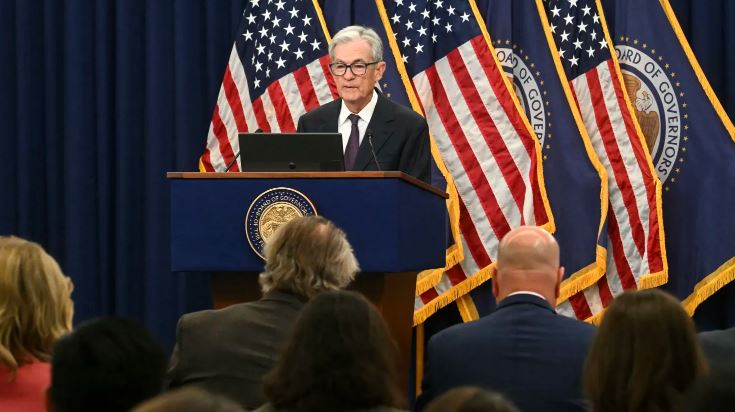
US Federal Reserve Chair Jerome Powell speaks at a news conference at the Federal Reserve headquarters, following the Federal Open Market Committee (FOMC) meeting in Washington, DC, on Sept. 17, 2025. Jim Watson | AFP | Getty Images
The Rate Cut Decision
The Federal Reserve lowered the federal funds rate by a quarter percentage point on Wednesday, bringing the benchmark rate to a target range of 3.75% to 4.00% . This marks the second consecutive cut after September’s reduction, bringing borrowing costs to their lowest level since 2022 .
The policy-setting Federal Open Market Committee approved the move with a 10-2 vote, revealing ongoing divisions among policymakers . Governor Stephen Miran dissented in favor of a more aggressive half-point cut, while Kansas City Fed President Jeffrey Schmid preferred to hold rates steady .
In addition to the rate cut, the Fed announced it will conclude the reduction of its securities holdings on December 1, a process known as quantitative tightening that further eases financial conditions .
The Economic Dilemma
The Fed’s decision reflects the challenging economic crossroads the United States currently faces. On one hand, the central bank noted that “economic activity has been expanding at a moderate pace” . On the other, policymakers expressed specific concern about employment, stating clearly that “downside risks to employment rose in recent months” .
This tension was evident in the Fed’s official statement, which acknowledged that “job gains have slowed this year, and the unemployment rate has edged up but remained low through August” while simultaneously noting that “inflation has moved up since earlier in the year and remains somewhat elevated” .
The situation creates a complex policy challenge for the Fed, which has a dual mandate to maintain maximum employment while keeping inflation stable at 2%. With the labor market showing signs of strain and inflation running at 3% as of September—well above the target—the central bank has been forced to prioritize which risk to address .
The Data Blackout Complication
Compounding the Fed’s decision-making challenge is an ongoing federal government shutdown that has halted the publication of key economic indicators . For weeks, policymakers have been operating without official data on employment, consumer spending, and other critical metrics that typically inform their decisions.
“This is like flying blind,” said Claudia Sahm, chief economist at New Century Advisors, in an interview with CNBC. “The Fed began reducing rates again because it is concerned that the labor market will be deteriorating and that you could have this slow job creation that we’ve seen turn into actually a contraction in jobs” .
The Chicago Fed has attempted to fill the information gap with its own labor market indicators, estimating the unemployment rate at approximately 4.35% in October, up from the officially reported 4.3% in August . Their data suggests hiring rates for unemployed workers have declined to 45.18%, while separations including layoffs have edged up to 2.09% .
Behind the Labor Market Concerns
While the unemployment rate remains relatively low by historical standards, deeper concerns have emerged about the health of the job market. The most recent official data from August showed the unemployment rate at 4.3%, up from 4.2% the previous month . More troubling, however, is the rising duration of unemployment spells.
According to research from the Minneapolis Fed, long-term unemployment—defined as being jobless for 27 weeks or more—has begun to creep upward again after a remarkable recovery following the COVID-19 pandemic . As of August 2025, approximately 25.7% of all unemployed workers fell into this long-term unemployed category, meaning roughly 1 in 4 job seekers had been looking for work for six months or more .
This trend is particularly concerning because long-term unemployment can become self-perpetuating. Research shows that job seekers often lose momentum, skills deteriorate, and employers are less likely to hire applicants with extended employment gaps .
Inflationary Pressures Persist
On the other side of the Fed’s dilemma, inflationary pressures continue to complicate the policy picture. The annual inflation rate climbed to 3% in September, moving further away from the Fed’s 2% target .
Many economists attribute persistent price pressures to ongoing trade tensions and tariffs. “The tariffs are the biggest tax increase since the late 1960s,” said Luke Tilley, chief economist at Wilmington Trust financial group .
The Fed’s preferred inflation gauge, the Personal Consumption Expenditures index, also remained above the 2% target in August, the last reading published before the government shutdown halted data releases .
Expert Perspectives on the Fed’s Move
Fed Chair Jerome Powell had hinted at the central bank’s direction earlier in October, warning that “there is no risk-free path for policy as we navigate the tension between our employment and inflation goals” . Similar remarks accompanied September’s rate cut decision, suggesting the Fed was preparing to prioritize labor market concerns over inflationary ones.
Other Fed officials have expressed more cautious views. Fed Governor Christopher Waller, a finalist to succeed Powell as chair, noted recently that “something’s gotta give” in the economic picture . “Either economic growth softens to match a soft labor market, or the labor market rebounds to match stronger economic growth,” Waller added, while urging his colleagues to “move with care when adjusting the policy rate to ensure we don’t make a mistake that will be costly to correct” .
The divided vote on Wednesday’s decision reflects these ongoing debates within the central bank about the appropriate pace of easing .
Market Reaction and Economic Impact
Financial markets responded positively to the Fed’s decision, with major stock indices maintaining gains after the announcement . The Nasdaq Composite climbed 0.5%, while the S&P 500 and Dow Jones Industrial Average also advanced, with all three indexes reaching new all-time intraday highs .
For consumers, the rate cut could bring some relief to borrowing costs. Since most credit cards have variable rates, there’s typically a direct connection to the federal funds rate, meaning interest charges on card balances could decrease within a billing cycle or two . Other types of loans, including auto loans and some mortgages, may also see modest rate reductions, though the effects are typically less immediate .
The unusual circumstance of the Fed cutting rates while markets trade at record highs has drawn attention from analysts. JPMorgan’s trading desk noted that it’s highly unusual for the central bank to cut rates when the market is hitting all-time highs—an event that has happened only four other times by the firm’s count . Historically, these rare instances have been bullish for markets, with the S&P 500 posting an average return of 20% one year out in such scenarios .
What Comes Next for the Fed?
Looking ahead, all eyes turn to the Fed’s December meeting, though the central bank has offered little explicit guidance about its plans. With the government shutdown continuing and key data unavailable, the Fed has emphasized it will “carefully assess incoming data, the evolving outlook, and the balance of risks” .
Bank of America economists believe that despite the data limitations, the Fed’s inclination would be to seek another reduction before year-end, though they note Powell is unlikely to commit to such a move at this stage .
“The Fed will acknowledge the recent strength of economic activity. But the broader shift in focus toward the labor mandate probably won’t change,” said Bank of America U.S. economist Shruti Mishra .
The broader economic picture remains uncertain. While the labor market shows signs of softening, economic growth appears resilient, powered in part by significant investments in artificial intelligence technology . Major stock market indexes continue to set records, largely driven by the AI investment boom, though this has raised concerns about potential bubbles .
Navigating Uncertain Waters
As the Fed navigates these uncharted economic waters, its commitment remains supporting maximum employment and returning inflation to its 2% objective . The path forward, however, depends heavily on how the economic picture evolves once official data becomes available again and whether the tension between the job market and inflation begins to resolve.
For now, the Federal Reserve has signaled its willingness to act preemptively to protect the job market, even in the face of persistent inflation. The success of this strategy will only become clear in the months ahead as the economic landscape continues to shift.
The Federal Reserve chose to cut interest rates because rising concerns about a lagging job market and increased unemployment risks outweighed the concerns about persistent inflation. The Fed has a dual mandate, and it determined that the immediate danger to employment was more pressing than inflation, which remains above its 2% target but has stabilized.
The Fed’s rate cut will likely lead to a slight decrease in borrowing costs over the next one to two billing cycles. Specifically, interest rates on variable-rate debts like credit cards, home equity lines of credit (HELOCs), and some auto loans may see a small reduction. However, the effect is not always immediate or uniform across all lenders.
Following the latest quarter-point cut, the Federal Reserve has set the federal funds rate to a target range of 3.75% to 4.00%. This is the benchmark rate that influences borrowing costs throughout the economy.
While the Fed has not made an official commitment, financial markets and many economists widely expect another rate cut at the December meeting. The central bank has signaled that its future decisions will depend on the evolution of the job market, and if employment data continues to soften, a third consecutive cut is highly probable.
The government shutdown has created a significant challenge for the Fed by halting the publication of key official economic data, including employment reports, inflation numbers, and retail sales. This forces the Fed to “fly blind,” relying on incomplete private-sector data and regional surveys, which adds a layer of uncertainty and complexity to its rate-setting deliberations.